Hankyung Business
Published in Hankyung Business on Aug 31, 2020
The film "The Social Network" portrayed Mark Zuckerberg as a character as complicated as Facebook's own tangled origin story.
Bitcoin A to Z
-A boom stronger than 2017 is in the offing: a maturing ecosystem, legal frameworks in place, institutional accumulation
The film "The Social Network" painted an absorbing portrait of Mark Zuckerberg, the Facebook chief executive officer (CEO), whose character is as complicated as Facebook's own tangled origin story.
The Winklevoss twins, the "insiders" of the Harvard campus, ask Zuckerberg, who had a reputation as a hacker, to write a program based on their idea. Zuckerberg wrote the program, and that is how Facebook was born.
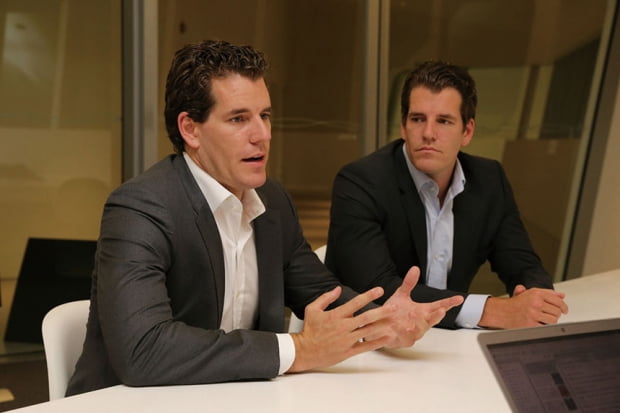
In contrast to its three-dimensional Zuckerberg, the film depicts the Winklevoss brothers as stock types. They are white, sons of a wealthy family, born with silver spoons and athletic enough to reach the Olympic finals. They stand in sharp contrast to Zuckerberg -- Jewish, ordinary in appearance, the sort who gets dumped by his girlfriend. Yet in the world of Bitcoin, few figures are as multidimensional as the Winklevoss brothers.
The lawsuit over Facebook's birth ended in a settlement. In 2013, when the brothers poured a substantial portion of the $65 million (about 77.16 billion won) they received in that settlement into Bitcoin, the story of the Winklevoss twins and Zuckerberg entered a new phase. If a sequel to the film is ever made, it might well open with a scene in which the brothers, resting on some island in the South Pacific, hear about Bitcoin from someone, think of Zuckerberg, and break into an ambitious smile.
The brothers, it is said, sensed intuitively that Bitcoin could become something bigger than Facebook. They invested boldly and secured 130,000 BTC, roughly 1% of the Bitcoin in circulation at the time. The reason Zuckerberg blocked the use of Bitcoin wallets on Facebook may have been that he intended to issue his own cryptocurrency later -- but it may also have had to do with his feelings toward the Winklevoss brothers.
Although it began on the Harvard campus, Facebook spent its growth years in Silicon Valley on America's West Coast. The keyword for understanding the Winklevoss brothers, by contrast, is the American East. They were convinced that for Bitcoin to grow it had to be connected to the establishment financial industry of the East Coast. And so they filed early for a Bitcoin exchange-traded fund (ETF). Absorbing enormous legal costs in order to get over the wall of bureaucracy, they devoted themselves to the "Easternization" of Bitcoin.
The "2017 Boom" That Prompted Governments to Build Legal Frameworks
They also actively cooperated in the introduction of New York State's BitLicense bill, the first law in the United States to regulate the Bitcoin industry, and as soon as it passed they obtained -- as if they had been waiting for it -- operating approval for Gemini, the crypto exchange they had founded. At the time, the Bitcoin mainstream shared the sensibility of the counterculture movement that originated on America's West Coast, and so they understood the New York BitLicense bill as a government conspiracy to suppress Bitcoin and cryptocurrency. In the eyes of the Bitcoin mainstream, what the Winklevoss brothers did was not merely a deviation but a betrayal.
The Bitcoin ETF they labored over was never approved in the end. But the direction the brothers pointed to later became the mainstream view of the industry, and so they established themselves as influential leaders. A few months ago they lavished praise on Chainlink, and its price subsequently jumped more than 500%. It was an episode that showed vividly just how much influence they wield.
Recently Cameron Winklevoss, co-founder of Gemini, predicted on Twitter that the coming crypto bull market will look very different from that of 2017. He offered as grounds the maturation of the ecosystem and inflation in fiat currency. In other words, he was pointing to upward pressure far more solid and far more powerful than the boom of 2017.
The 2017 boom was driven in part by the misconception that one could issue tokens and rake in money without having to worry about government officials. Once the United States and other major countries declared that they would regulate initial coin offerings (ICOs), the ICO boom and the crypto boom went out together. But 2017 also served as a springboard for growth. Many startups squandered their easily raised capital in absurd ways, yet many other companies poured their energy into infrastructure, the foundation of the ecosystem. The level of understanding among investors and the public also rose, and to that extent the room for half-baked coin projects to appear shrank. Blockchain-cures-everything rhetoric faded, and in its place the industrial sectors that actually suit blockchain came to the fore. The talk of the industry now is DeFi (decentralized finance), and the potential for direct finance using blockchain grows by the day. The more one savors the fact that cryptocurrency is the starting point of financial innovation, the more the discernment of the Winklevoss brothers -- who advocated establishing a relationship with the American East, the center of global finance -- stands out.
Above all, the greatest achievement of the 2017 boom and bust was that it gave governments the occasion to put legal frameworks in order. Korea, too, recently finalized the relevant tax rules. In the United States, the framework has been developed to the point where banks may handle cryptocurrency. In other words, investors no longer have to invest while weighing the public's fear that the government might one day suddenly shut down the exchanges.
Bitcoin's price may already be too expensive for individuals to buy. Of course one can purchase 0.001 BTC, but it does not feel good. Accordingly, many take the view that Bitcoin's upside will be limited. Yet the likelihood has grown that Bitcoin will be accumulated not by individuals but by institutions. To individuals hoping for a hundredfold rise, Bitcoin may already seem a ponderous, mature asset. But institutions, which by the principles of asset management have no choice but to prize safety, will actually prefer Bitcoin.
Bitcoin Begins to Acquire "Price Stability"
Grayscale, which is entrusted by institutions with investing in cryptocurrency, is sustaining explosive growth. Not long ago MicroStrategy, the world's largest business intelligence provider and a Nasdaq-listed company, sent a shock through the market by disclosing that it had bought $250 million worth of Bitcoin -- 21,454 coins in total. Its official reason for investing in Bitcoin was that, because of inflation, holding corporate assets in cash carries excessive risk.
Beyond ecosystem growth, inflation and institutional investment, there is one more factor to watch: capital flight beyond China's borders. The possibility was already raised during last year's Hong Kong unrest. Since then, the U.S.-led decoupling from China has been unfolding at a faster pace, drawing even more attention. The slush funds of Chinese Communist Party leaders hidden in Swiss banks have already become the center of controversy. The claim is that enormous sums -- more than a trillion won per person -- have been concealed in Swiss banks. There is a possibility that the Swiss banks will disclose the list of names. In short, all three of the asset havens preferred by China's wealthy -- Hong Kong, the United States and Switzerland -- look likely to be compromised. The likelihood has therefore risen that China's wealthy will consider acquiring Bitcoin and burying it away for the long term. As long as no transaction is generated, mined coins kept in the form of a paper wallet are not only impossible to detect but also impossible to catch when they cross a border.
The blockchain analytics firm Chainalysis has already estimated that roughly $50 billion (about 59 trillion won) flowed out of China via cryptocurrency over the past year. Because this is a simple transfer, Tether -- whose price is pegged to the dollar -- is used more often than Bitcoin; but the fact that Tether's management is currently under indictment by prosecutors in New York is an important variable. Investment in Tether is likely to be identified by U.S. financial authorities. In the end, the final choice of China's wealthy is likely to be Bitcoin as well.
It has been nearly eight years since people like the Winklevoss brothers, who aim at the institutional mainstream, first threw themselves into Bitcoin. Just as they envisioned, Bitcoin has begun its encounter with the establishment. Perhaps the true reason for Bitcoin's existence is precisely the desire of citizens and individuals across the globe to secure a link to the global establishment.